Why Were Severe Burns Treated Without Anesthesia in the Past?
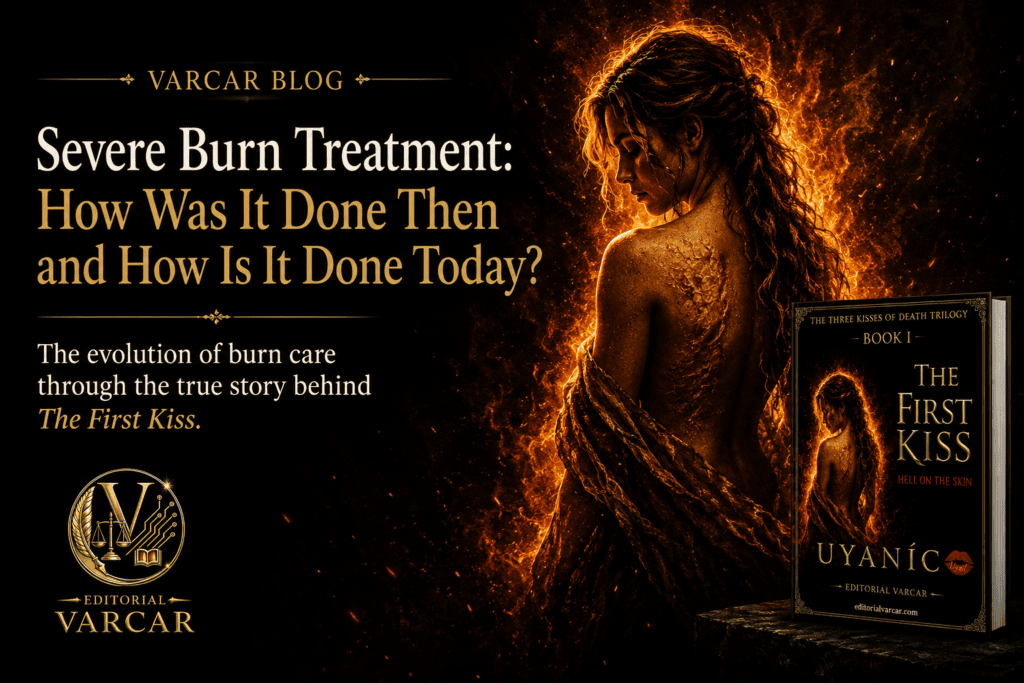
What the Prologue of “The First Kiss” Reveals — and What Medicine Does Today
There’s a question Uyanic carried for decades, ever since she survived a fire at age ten: why didn’t they put me to sleep?
That question opens the prologue of The First Kiss: Hell in the Skin, the first book in the trilogy The Three Kisses of Death. It’s a real testimony, written from the body’s own memory, about debridement sessions in a steel tub, without anesthesia, while medical staff scraped away burned skin to prevent infection.
Today we know that question has an answer. And we also know that if that same girl were admitted to a burn unit in 2026, her experience would be radically different. This article compares both realities: the one the book narrates, and the one that exists today in modern medicine.
Why They Didn’t Put Her to Sleep: The Medical Logic of the Time
The prologue doesn’t accuse anyone. On the contrary, it names with precision the dilemma doctors faced:
A severely burned body doesn’t tolerate general anesthesia well. The heart, kidneys, and lungs are already at their limit; shutting down the central nervous system could be more dangerous than keeping the patient awake. Under that logic, prioritizing the body’s survival outweighed avoiding suffering.
There was also no clear place to inject a sedative. In a third- or fourth-degree burn, three types of tissue coexist at once: dead skin with no nerves, sensitive edges where the pain is excruciating, and regenerating nerves sending distorted pain signals. There was no — as the book describes it — precise map for relieving pain without adding risk.
The result: pain became what the text calls “a secondary variable in the equation of survival.” Not out of indifference, but because the science of the time had no other tool.
📖 Full testimony
Want to read the full prologue? Get the prologue and first chapters of The First Kiss, personalized with your name.Get my free preview
What Changed: Burn Medicine in 2026
Four decades later, nearly every assumption behind that dilemma has been replaced with new tools.
1. Deep Sedation, Not “Tolerated Suffering”
It’s no longer a choice between classic general anesthesia (with all its risks) or nothing. Today, anesthesiologists apply multimodal sedoanalgesia directly in the treatment room: the patient enters a state of sleep and insensibility, without losing the cardiorespiratory stability that once forced doctors to keep them awake.
2. Drugs That Didn’t Exist Then
- Ketamine and dexmedetomidine, which disconnect the brain’s pain receptors and produce protective amnesia: the patient doesn’t remember the procedure.
- Ultra-short-acting opioids, like fentanyl or remifentanil in continuous infusion, adjustable minute by minute based on the patient’s response.
3. Pain Stopped Being “Secondary”
This is perhaps the deepest change. Current evidence shows that extreme pain isn’t just cruel: it damages the heart, disrupts the immune system, and delays healing. Controlling it is no longer an optional gesture of compassion — today it’s a widely adopted standard of good clinical practice for patient recovery.
4. Farewell to the Steel Tub and Manual Scraping
Aggressive manual debridement techniques are being replaced by:
- Topical enzymes that dissolve dead tissue without touching healthy tissue.
- Hydrosurgery, surgical-pressure water jets, faster and less invasive.
- Temporary synthetic dressings, which reduce the need for painful daily dressing changes.
Between Testimony and Protocol
None of this erases what happened. The value of The First Kiss isn’t in denouncing an era — it’s in naming with honesty a pain that for a long time had no explanation and no words. As the author herself writes:
“The memory of pain deserves, at the very least, the dignity of an explanation.”
Comparing yesterday to today isn’t just a medical exercise. It’s also a way of understanding how much medicine’s understanding of human suffering has changed — and why stories like this one matter, so that change is never forgotten.
Frequently Asked Questions About Burn Treatment
Does burn debridement hurt?
In the past, without proper sedation, manual debridement was extremely painful. Today, multimodal sedoanalgesia is designed so the patient neither feels nor remembers the procedure, though the response can vary case by case and sometimes requires additional rescue analgesia.
Why wasn’t anesthesia used before?
In third- and fourth-degree burns, the risk of cardiorespiratory collapse under general anesthesia was too high, and the damaged tissue didn’t respond well to local sedatives.
What is the book “The First Kiss” about?
It’s a real survival testimony narrating the experience of Uyanic, who at age 10 faced these medical protocols and found in writing her path toward healing.
Still wondering about the answer? Uyanic answered it in The First Kiss: Hell in the Skin — a real testimony about burns, debridement without anesthesia, and what came after.Get the full book →
Or start free: get the prologue and first chapters

¿Te quedaste con la historia?
Conoce el testimonio completo en The Three Kisses of Death - The Complete Trilogy — edición digital personalizada.
EPUB personalizado · Compatible con todos los dispositivos