“It’s just a match”: when the body doesn’t agree, then and now
What the chapter “The Cursed Match” reveals — and what childhood PTSD treatment looks like today
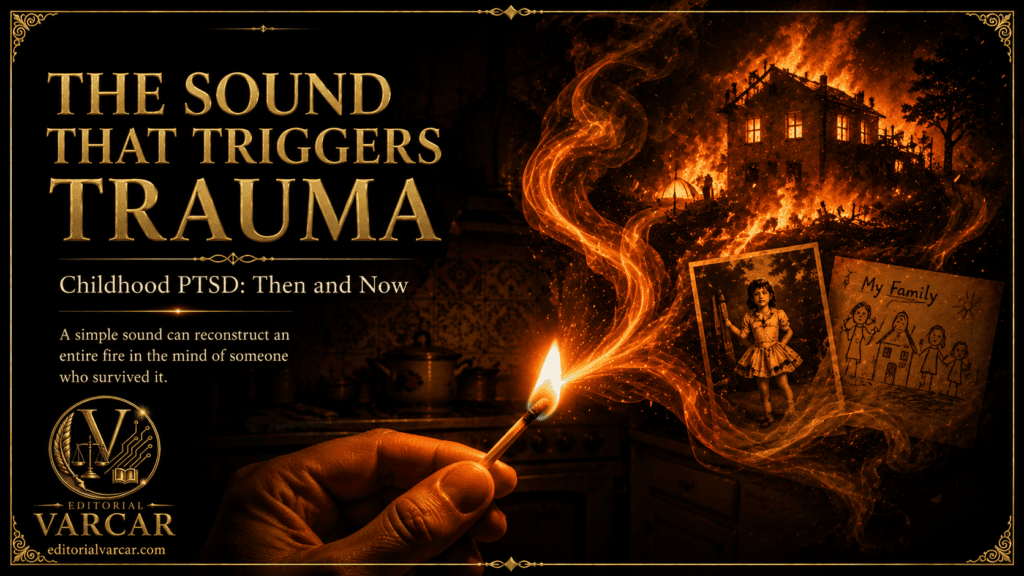
Not every trauma trigger is visual. In The First Kiss: Hell in the Skin, an everyday sound — the dry strike of a match being lit in the kitchen — is enough to make Uyanic’s body react as if the fire were happening all over again:
“It wasn’t the pain I remembered. It was the sound. That same dry snap, infinitely amplified by the memory of trauma… My brain, that efficient traitor, didn’t need images. With that sound, it rebuilt everything.”
📖 Want to read that whole chapter?
Get the first chapters, personalized with your name.
The response back then: “it’s just a match”
In the book, the response from those around her — loving, but with no clinical tools — is to soothe with logic: “It’s grandma, sweetheart. She’s making lunch. It’s just a match.” Uyanic herself recognizes the gap between that logic and what her body was experiencing:
“‘It’s just a match.’ The words were a logical nonsense. For her, for the world, it was true. For the neural pathways burned into my brain, it was a declaration of war.”
Nowhere in the chapter is there any mention of specialized therapy to process that trauma — the only approach available at that time and place was the family’s emotional support, with no clinical framework for what today has a name and a protocol.
📖 A real testimony, not a medical guide
This book doesn’t replace a medical or psychological consultation — it’s the first-person account of living with a trigger with no tools to process it clinically. Get the prologue and first chapters free
What changed: childhood trauma treatment today
What the book describes — a specific sound reactivating a full panic response, physical symptoms included — is today a well-documented symptom with a clinical name: a post-traumatic stress trigger.
1. Childhood diagnosis wasn’t always recognized as distinct from an adult’s
It wasn’t until 1987 that diagnostic criteria acknowledged children’s trauma responses could differ from adults’ — almost the same era the book’s story takes place in. Before that, the clinical framework for understanding what Uyanic was living through practically didn’t exist.
2. Evidence-based therapies, not just emotional support
Today there are therapies with solid clinical evidence for childhood trauma, including trauma-focused cognitive behavioral therapy and gradual, controlled exposure to feared stimuli — the same kind of sound that, in the book, was only ever avoided, never actively processed.
3. EMDR: a tool that didn’t exist then
Eye Movement Desensitization and Reprocessing (EMDR) therapy can help children and adolescents when delivered by a trained professional, helping the brain reprocess specific traumatic memories — exactly the kind of sound-linked sensory memory the book describes so clearly.
4. Working with the family as part of treatment, not just the child
Current childhood trauma protocols integrate direct work with caregivers, not just the child — recognizing that the family’s response (like the book’s “it’s just a match”) is part of the process, for better or worse, even when it always comes from love.
Between the testimony and the protocol
No one in Uyanic’s home did anything wrong. Her mother and grandmother responded with all the love and common sense they had. What was missing wasn’t care — it was a clinical framework that, at the time, was only beginning to be recognized in the medical literature. Today that same episode would have a name, a protocol, and specific tools from day one.
Frequently asked questions about childhood trauma and its triggers
Why can an everyday sound cause such an intense reaction?
Because traumatic memory can become linked to specific sensory cues — a sound, a smell — that the brain recognizes as a sign of imminent danger, triggering a fear response even when the current situation is completely safe.
Is childhood PTSD treated the same way as in adults?
No. Diagnostic criteria and therapeutic approaches for children differ from those for adults, something medicine only began formalizing toward the late 1980s.
What is “The First Kiss” about?
It’s the real-life testimony of Uyanic, who survived a fire at age 10 and describes in the book, among other things, how an everyday sound could fully reactivate the terror of that night.
Want the rest of the story? Discover how Uyanic lived through it in The First Kiss: Hell in the Skin.
Or start free: get the prologue and first chapters

¿Te quedaste con la historia?
Conoce el testimonio completo en The Three Kisses of Death - The Complete Trilogy — edición digital personalizada.
EPUB personalizado · Compatible con todos los dispositivos